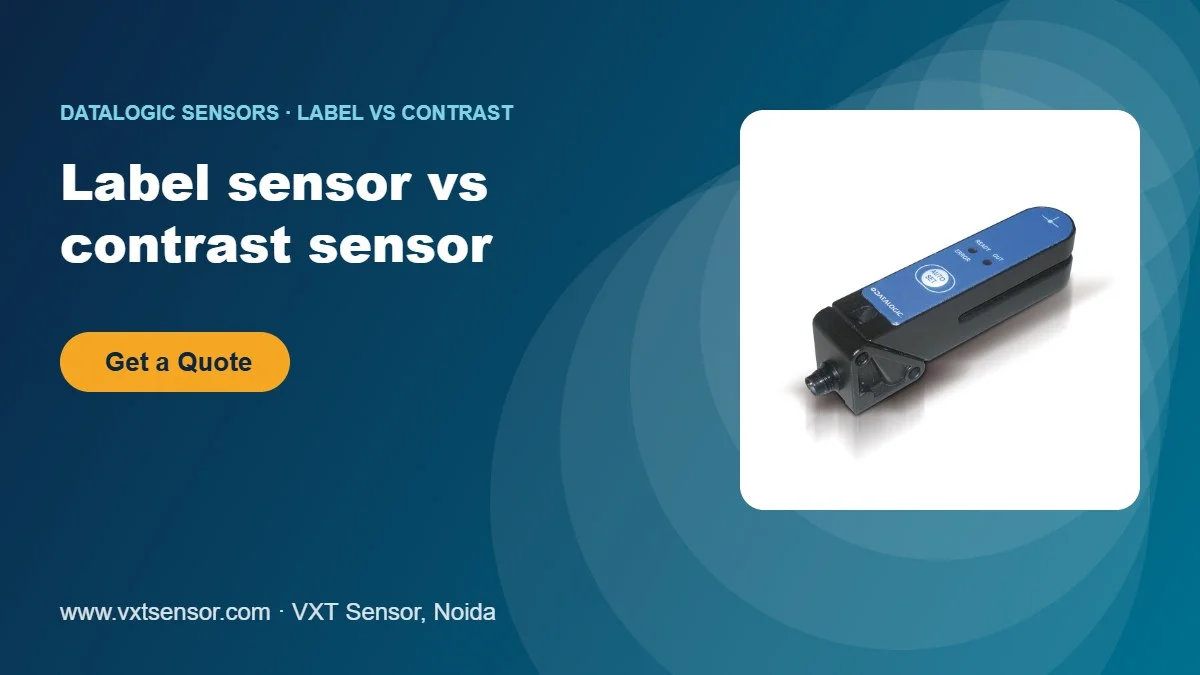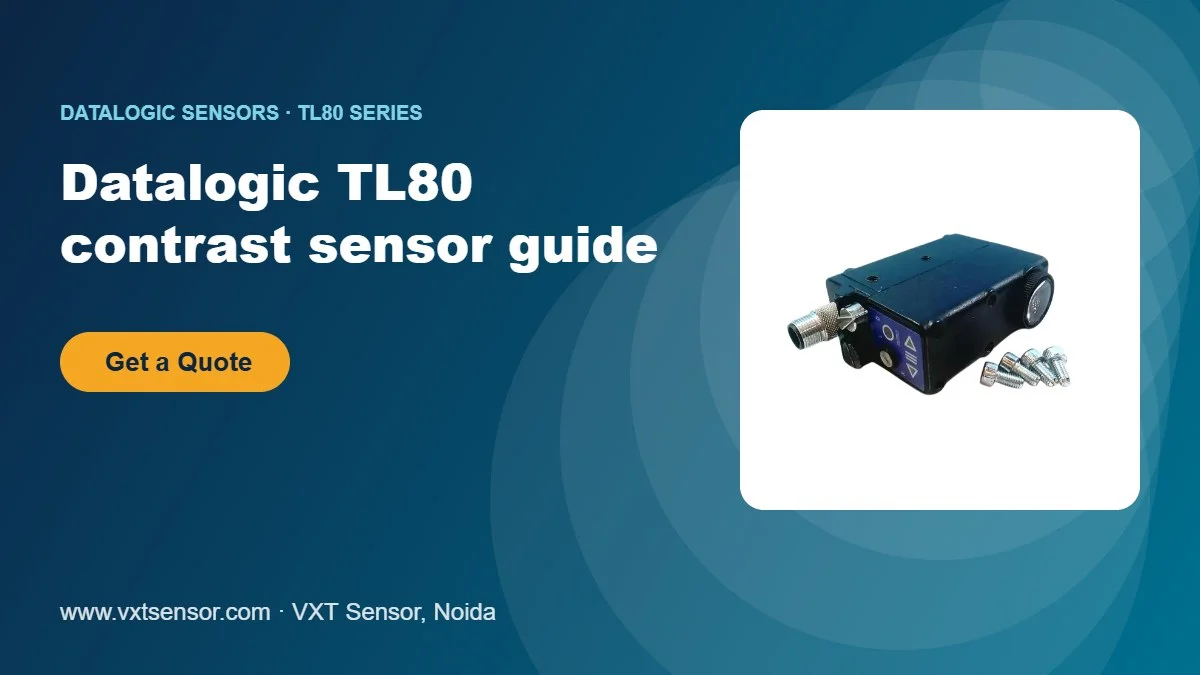
The Datalogic TL80 is a fast contrast sensor (also called a registration mark or eye-mark sensor) in a strong metal housing. It reads printed marks on film, paper and labels on packaging and printing machines, and stands out for its 10 kHz switching speed, interchangeable lenses and analogue output for checking contrast.
TL80 key specifications
| Specification | Value |
|---|---|
| Light emission | Green (526 nm) or red (630 nm) LED, selected by a switch |
| Lens / reading distance | 9 mm ±2, 18 mm ±2 or 28 mm ±3 |
| Light spot | 1.5 × 5 mm at 9 mm; 2 × 7 mm at 18 mm; 3 × 10 mm at 28 mm |
| Response time / switching frequency | 50 µs / 10 kHz (9 and 18 mm versions); 166 µs / 3 kHz (28 mm) |
| Output | NPN or PNP (selected by a jumper), 200 mA max |
| Analogue output | 0–5 Vdc proportional to reflected light (cable models) |
| Supply | 10–30 Vdc |
| Housing | ZAMA metal, IP67 |
| Connection | 3 m cable, cable with Amphenol connector, or M12 connector |
Values are from the Datalogic TL80 manual. The 9 mm and 18 mm lenses fit the same body, while the 28 mm lens needs its own body. Check the datasheet for your exact order code, such as the TL80-015.
How the TL80 works
The TL80 lights the material with a small spot and measures how much light comes back. A dark mark reflects less light than the background, so the output switches as each mark passes. Choosing green or red light lets you get the best contrast: green light usually works best for red, orange and yellow marks, and red light for blue, green and black marks.
The analogue output gives a voltage that rises with the amount of reflected light. Measure it on the mark and on the background to see which light colour gives the bigger difference.
Installation and set-up
- Mount the head at the focus distance of the lens (9, 18 or 28 mm) from the material.
- Tilt it 5–20° on shiny materials such as plastic film or metal foil, to avoid direct reflections.
- Select the light colour (green or red) with the switch, using the analogue output to compare if needed.
- Set the output type (PNP or NPN) and, if required, the output delay with the internal jumpers. Refit the cover and gasket carefully afterwards.
- Adjust the switching point so the output changes cleanly between mark and background, then test at full machine speed.
Typical applications
- Cutting and sealing registration on flow-wrap and pouch machines
- Print registration on printing and laminating machines
- Label and sleeve positioning
- High-speed lines where a 10 kHz sensor is needed
TL80 compared with other Datalogic contrast sensors
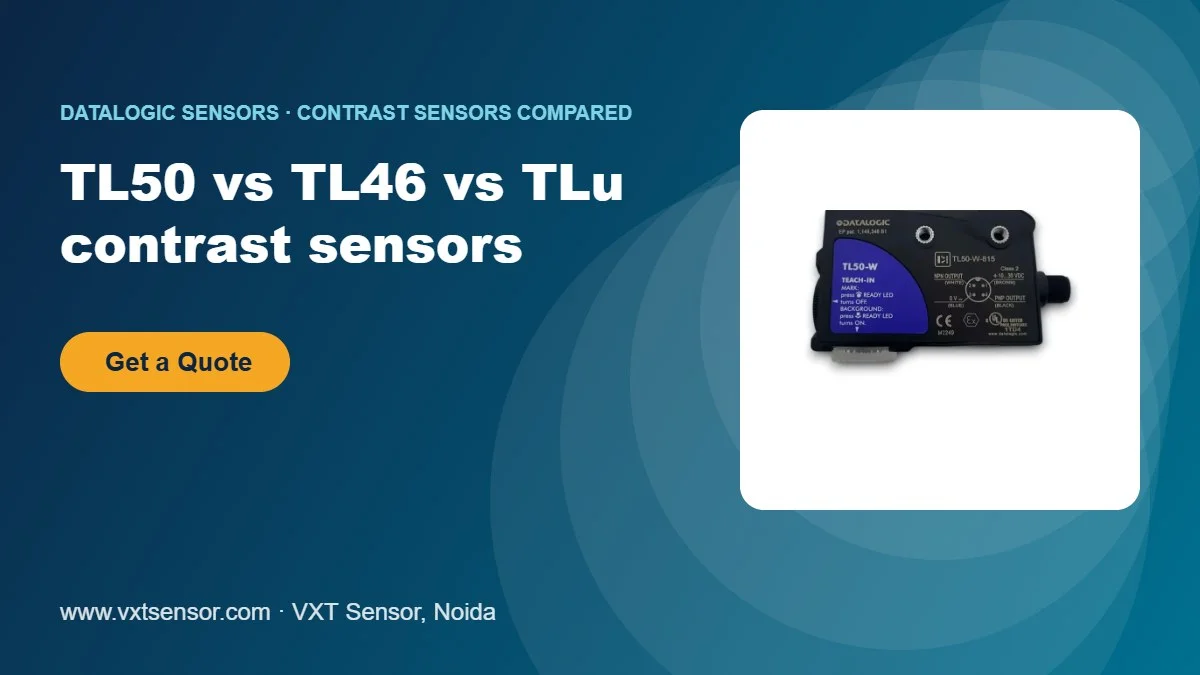
- TL50-W-815 – RGB light chosen automatically, push-button teach-in. See the TL50 guide.
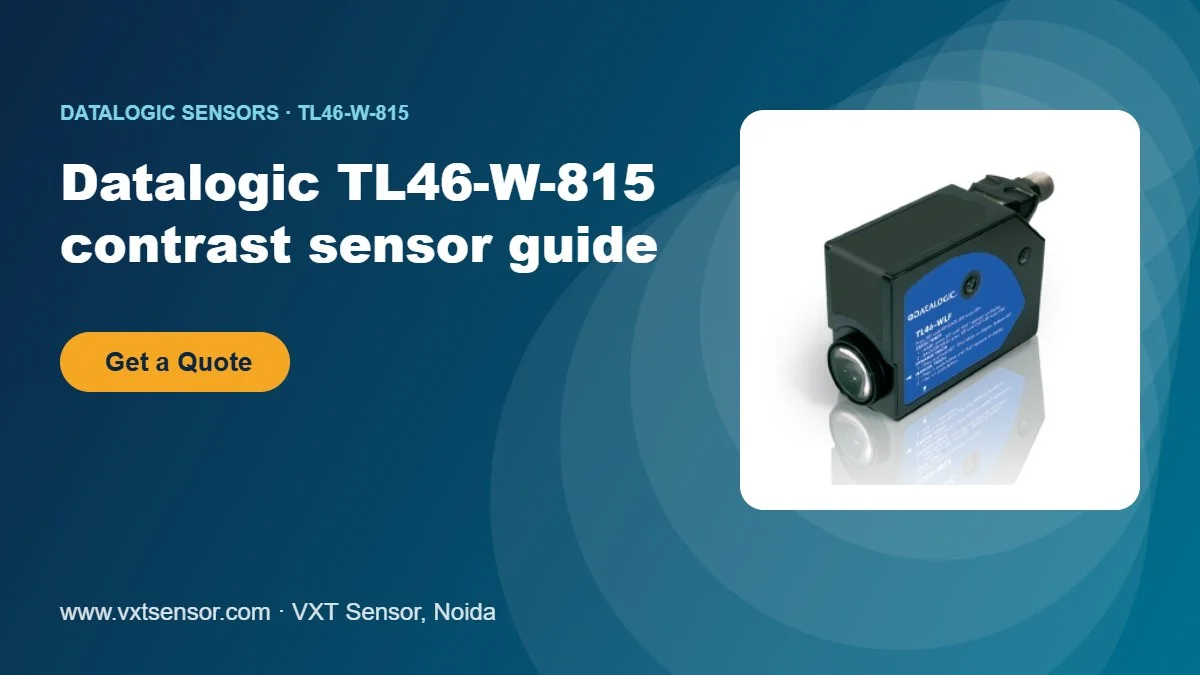
- TL46-W-815 – rugged RGB sensor with analogue output. See the TL46 guide.
- TLu-115 – compact contrast sensor. Compare all three in TL50 vs TL46 vs TLu.
Choose the TL80 when you want manual control of light colour, interchangeable lenses and very fast switching. For automatic RGB colour choice, the TL50 or TL46 is easier to set up. Read how to choose a Datalogic contrast sensor or see all contrast and colour mark sensors.
Frequently asked questions
What is the switching speed of the Datalogic TL80?
Up to 10 kHz (50 µs response) on the 9 mm and 18 mm versions, and 3 kHz on the 28 mm version.
Can I change the lens on a TL80?
Yes. The 9 mm and 18 mm lenses are interchangeable on the same body. The 28 mm lens needs its own body.
Should I use green or red light?
Use the colour that gives the biggest difference between mark and background. Green usually suits red, orange and yellow marks; red usually suits blue, green and black marks. The analogue output helps you compare.
Is the TL80 PNP or NPN?
Both. The output type is selected with an internal jumper.
What is the TL80 housing made of?
ZAMA metal, rated IP67.
Buy from VXT Sensor
VXT Sensor, Noida, supplies genuine Datalogic (Datasensing) sensors across India. Send us the model code or describe your application, and we will confirm the right model, datasheet, price and delivery time. Send an enquiry or call +91 99530 39482.
Looking for the right Datalogic sensor?
Genuine products from VXT Sensor, Noida. Tell us your application and we reply with the right model, price and delivery time.