Both sensors are used on labelling, printing and packaging machines, and both are sometimes called "mark sensors". But they detect different things and are built differently. Choosing the wrong type is a common reason for missed labels and wrong cuts.
The quick answer
| Label (fork) sensor | Contrast sensor | |
|---|---|---|
| Detects | The gap between labels on a backing (liner) | A printed mark (eye mark) on film, paper or carton |
| Shape | Fork (slot): the web runs through it | Rectangular: looks at the material from one side |
| Principle | Light passes through the web; the label changes the amount | Light reflects from the surface; the mark changes the amount |
| Typical distance | Material inside the fork slot (2 mm on the SR21) | About 9 mm in front of the sensor |
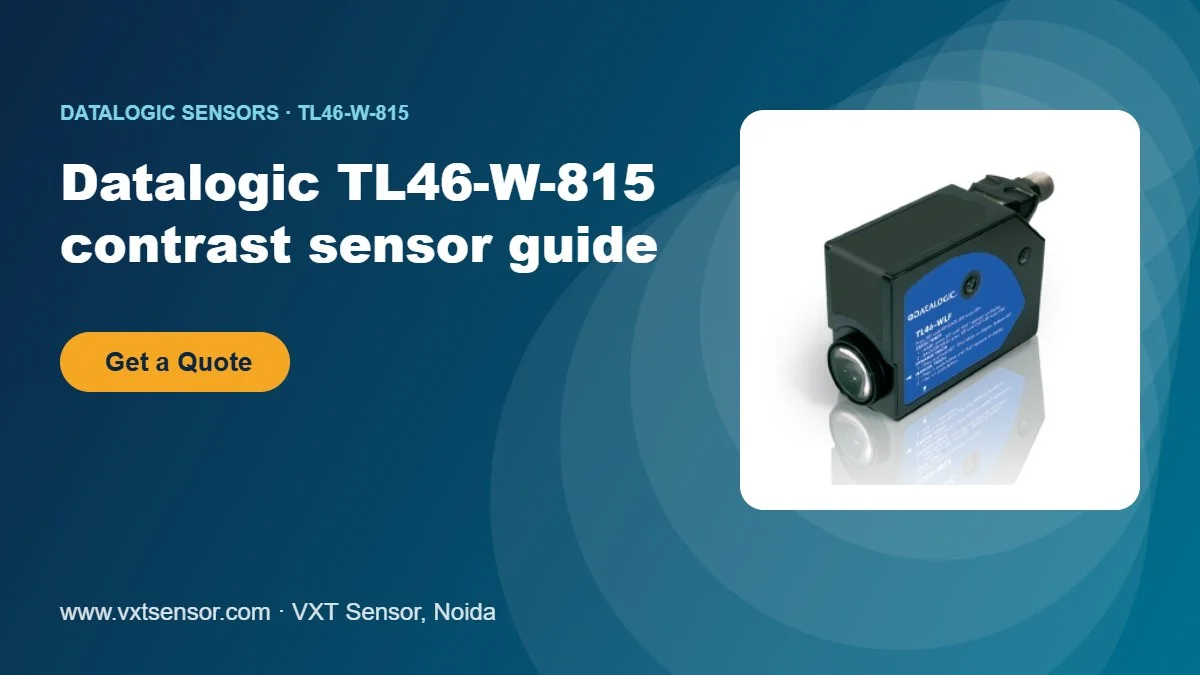
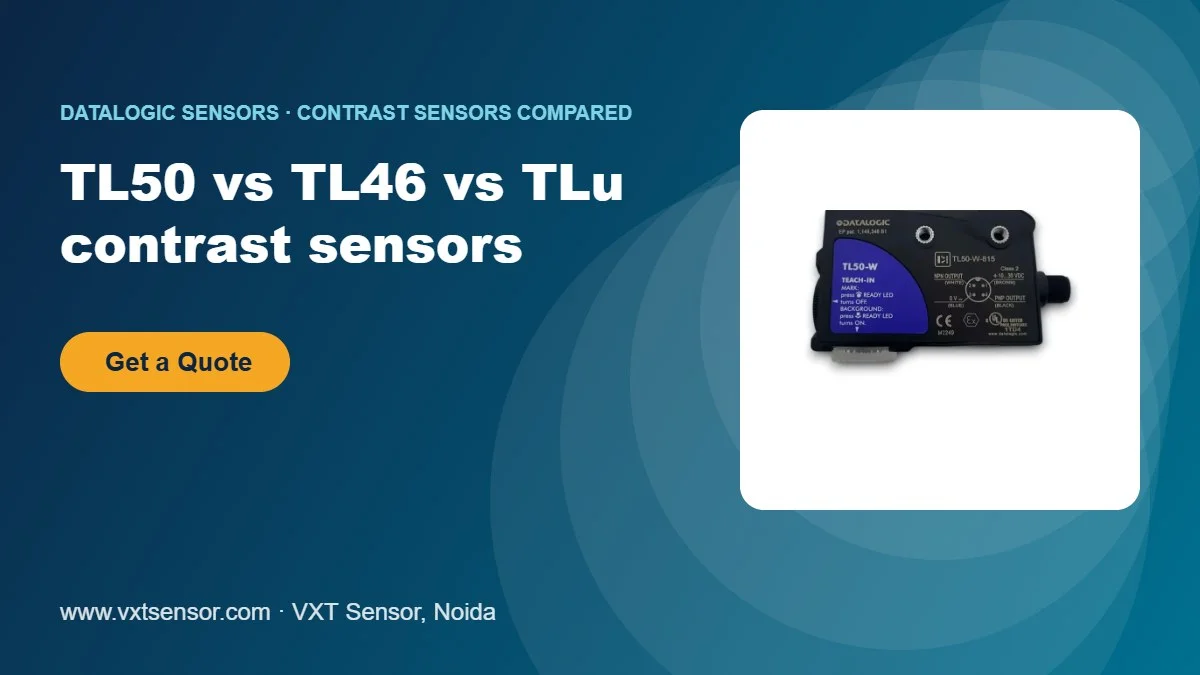
| Datalogic models | SR21-IR, SR23, SR31 | TL50-W-815, TL46-W-815, TLu-115 |
When to use a label (fork) sensor
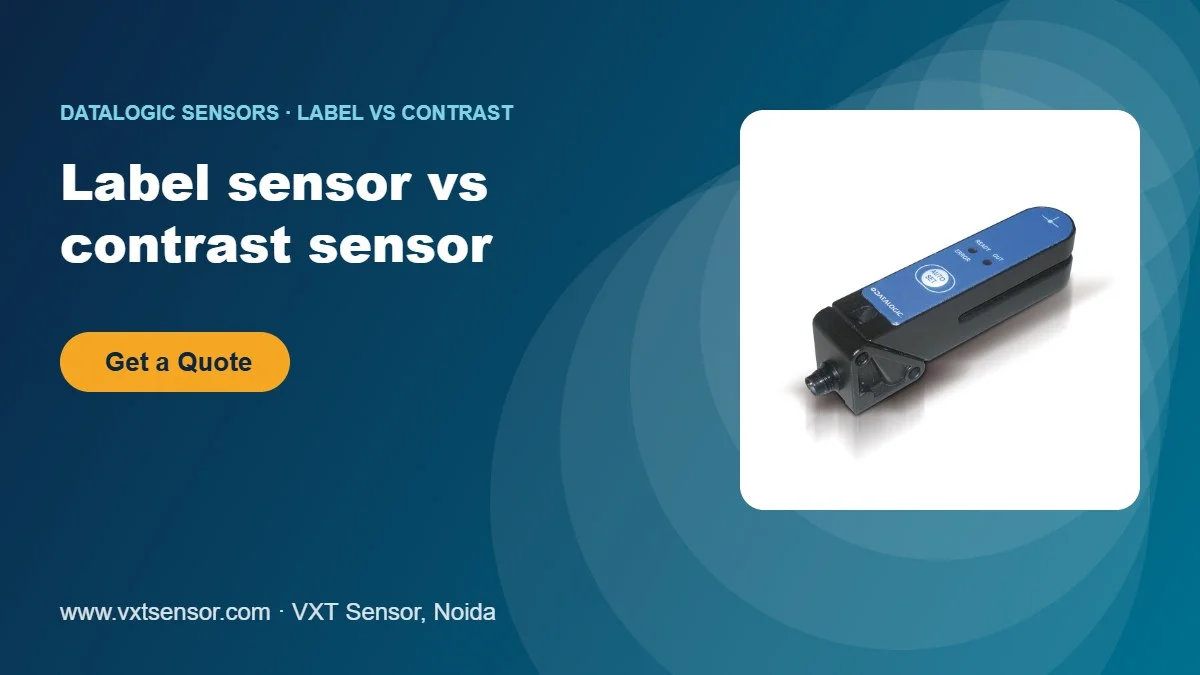
Use a fork sensor when self-adhesive labels sit on a backing paper and the machine must stop or dispense at each label. The SR21-IR uses infrared light through the web: where there is a label, less light passes; in the gap, more light passes. It has a 2 mm fork width, 0.5 mm resolution and a switching frequency up to 25 kHz, so it keeps up with fast labellers. Thicker webs and booklet labels suit the SR23 (5 mm fork), and the SR31 (30 mm fork) detects small parts, edges and larger objects.
Read more in our SR21, SR23 and SR31 label sensor guide.
When to use a contrast sensor
Use a contrast sensor when you need to detect a printed mark on a continuous web: registration marks on pouches and flow-wrap film, cut marks on printed rolls or marks on cartons. The sensor reflects light from the surface and switches when it sees the mark. RGB models such as the TL50-W-815 and TL46-W-815 handle coloured marks; red/green models such as the TLu-115 suit dark marks on light film.
Compare models in TL50 vs TL46 vs TLu.
Machines that use both
Many lines use both types: a labeller with a fork sensor for label gaps, and a contrast sensor on the product or carton to place the label in the right position. Printing and converting machines often use contrast sensors for registration and fork sensors for finished labels.
Frequently asked questions
Can a contrast sensor detect label gaps?
Sometimes, if the label and backing have a strong colour difference, but a fork label sensor is much more reliable because it measures through the web.
Can a label sensor read printed marks?
Fork sensors are designed for gaps and are not a good choice for printed registration marks. Use a contrast sensor.
Which sensor detects transparent labels?
Clear labels on a clear backing are difficult for standard optical fork sensors. Tell us the label and backing material and we will suggest a suitable Datalogic solution.
How do I set up an SR21-IR?
Place the backing paper (gap) in the fork and teach, then the label. Our label sensor guide has step-by-step instructions.
See all Datalogic label sensors and contrast sensors.
Buy from VXT Sensor
VXT Sensor, Noida, supplies genuine Datalogic (Datasensing) sensors across India. Send us the model code or describe your application, and we will confirm the right model, datasheet, price and delivery time. Send an enquiry or call +91 99530 39482.
Looking for the right Datalogic sensor?
Genuine products from VXT Sensor, Noida. Tell us your application and we reply with the right model, price and delivery time.