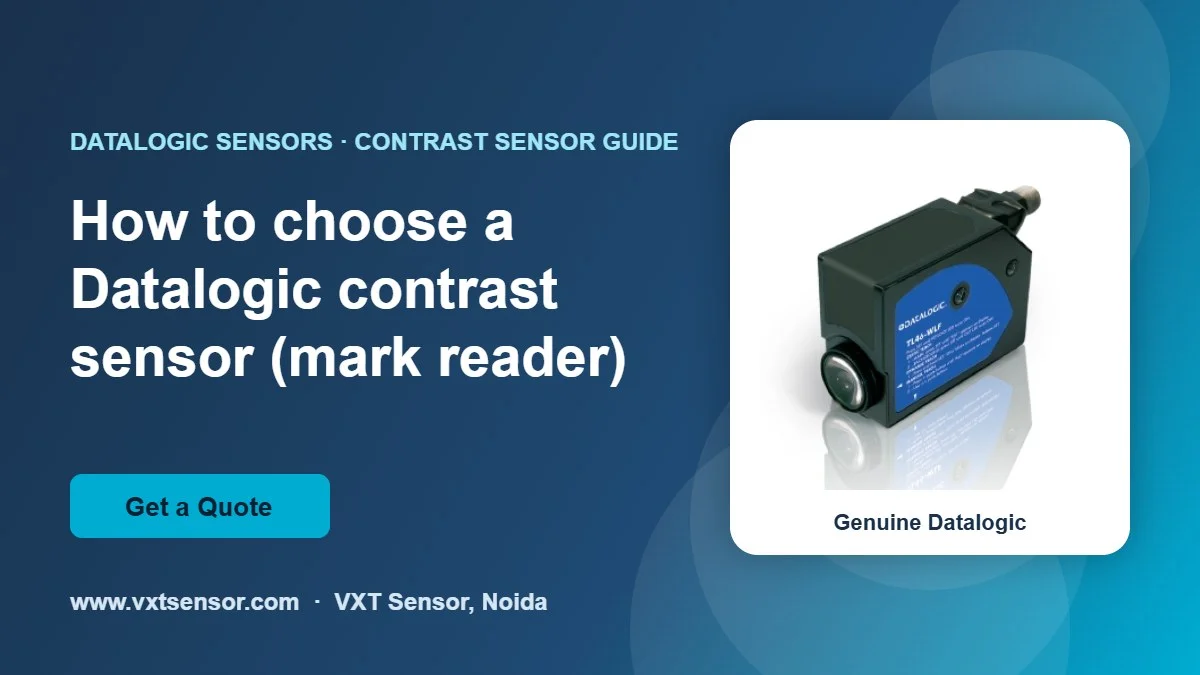
A contrast sensor, also called a mark reader or eye-mark sensor, detects the printed registration mark on packaging film, pouches, cartons and labels. It tells the machine exactly where to cut, seal or print. If the sensor misses marks, the machine cuts in the wrong place and film is wasted. Choosing the right contrast sensor is one of the simplest ways to reduce wastage on a packaging line.
How a contrast sensor works
The sensor shines a small light spot onto the moving material and measures how much light comes back. The printed mark reflects a different amount of light than the background. During teaching, the sensor learns the mark and the background and sets a switching point between them. Every time the mark passes under the spot, the output switches.
Two things decide how reliable this is: the light colour and the speed. A red mark on a white film is almost invisible in red light, but very clear in green light. That is why modern Datalogic contrast sensors offer several light colours or select the best colour automatically.
Datalogic contrast sensors compared
| Model | Light | Output | Connection | Best for |
|---|---|---|---|---|
| TLu-011 | Green 526 nm / red 630 nm | NPN, 200 mA | 3 m cable | Standard form-fill-seal machines |
| TLu-115 | Green 526 nm / red 630 nm | PNP + analogue | M12 4-pole | PNP machines, analogue signal for set-up |
| TL46-W-815 | RGB (blue, green, red) | PNP/NPN, 15 kHz | M12 5-pole | Fast lines and difficult colour pairs |
| TL50-W-815 | RGB, automatic colour | 1 PNP + 1 NPN, 15 kHz | M12 4-pole | Mixed jobs, frequent film changes |
| S8-PR-5-W03-PP | RGB, automatic selection | PNP, 10 kHz | M8 | Compact machines with little space |
All of these models work at 10 to 30 Vdc (the S8 from 12 Vdc) and are IP67 rated, so they handle dust and wash-down areas found in food and pharma packaging.
Five questions to ask before you buy
- What colours are the mark and the background? For simple black-on-white marks a two-colour sensor such as the TLu-011 is enough. For red, orange, yellow or low-contrast marks, choose an RGB model like the TL46-W-815 or TL50-W-815.
- How fast is the machine? High-speed lines need a short response time. The TL46-W-815 responds in 33 µs and switches up to 15 kHz.
- PNP or NPN? Check the input card of your PLC or controller. Many Indian machines use NPN; most European machines use PNP. The TL50-W-815 has both outputs, which makes it a safe replacement.
- Cable or connector? A connector (M12 or M8) makes replacement much faster during a breakdown.
- Is the film shiny or metallised? Glossy and foil films reflect light like a mirror. Mount the sensor slightly tilted (about 10–15°) so direct reflections do not reach the receiver.
Installation tips for stable mark detection
- Keep the operating distance at about 9 mm, the focus point of these sensors, within the ±3 mm depth of field.
- Mount the light spot (1.5 x 5 mm) at right angles to the mark direction so it covers the mark fully.
- Support the film under the sensor with a guide plate to stop flutter.
- Teach the sensor on the real film at running position, not on a loose sample.
Get the right sensor from VXT Sensor
VXT Sensor, Noida, supplies genuine Datalogic sensors across India. Send us your machine details, the object or mark you want to detect and the distance, and we will suggest the right model, share the datasheet and confirm price and delivery. Contact VXT Sensor or browse the full Datalogic product range.
Looking for the right Datalogic sensor?
Genuine products from VXT Sensor, Noida. Tell us your application and we reply with the right model, price and delivery time.