Most problems with photoelectric sensors are not faults in the sensor. They come from choosing the wrong sensing mode for the object, the distance or the background. This guide explains the main sensing modes and when to use each one, with examples from the Datalogic range.
1. Diffuse proximity
The emitter and receiver are in one housing. Light hits the object and some of it bounces back to the sensor. No reflector is needed, so installation is simple.
- Use for: detecting boxes, cartons and parts at short to medium distances.
- Watch out: dark or shiny objects reflect less light, and a bright background can be detected by mistake.
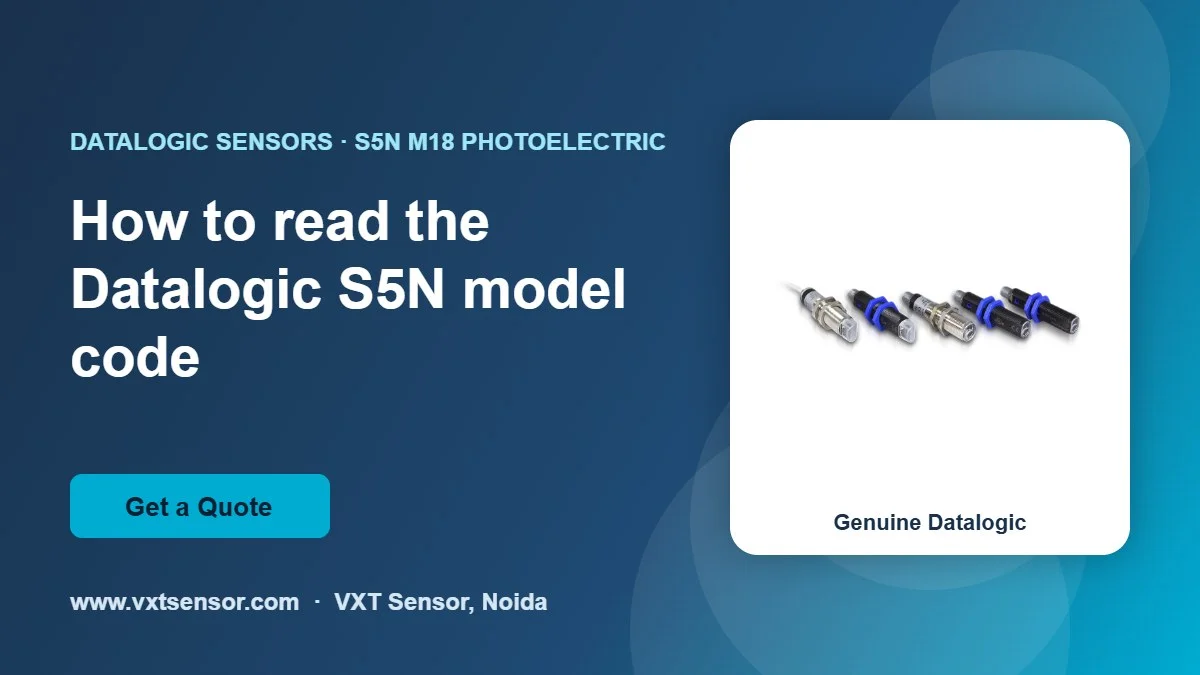
- Example: S5N-PA-5-C21-PP, M18, 0 … 400 mm; S3N-PR-2-C01-P, a miniature sensor sensing 1 … 250 mm.
2. Background suppression
A diffuse sensor that measures the angle of the returned light, not only its amount. It ignores everything beyond a set distance, so a shiny conveyor frame or wall behind the object is not detected.
- Use for: objects of different colours in front of a busy background.
- Example: S5N-PA-5-M03-PP.
3. Polarized retroreflective
The sensor sends light to a reflector opposite it and watches the returning beam. An object breaking the beam is detected. The polarizing filter stops shiny objects from being mistaken for the reflector.
- Use for: conveyors, doors and pallets across a longer distance, with wiring on one side only.
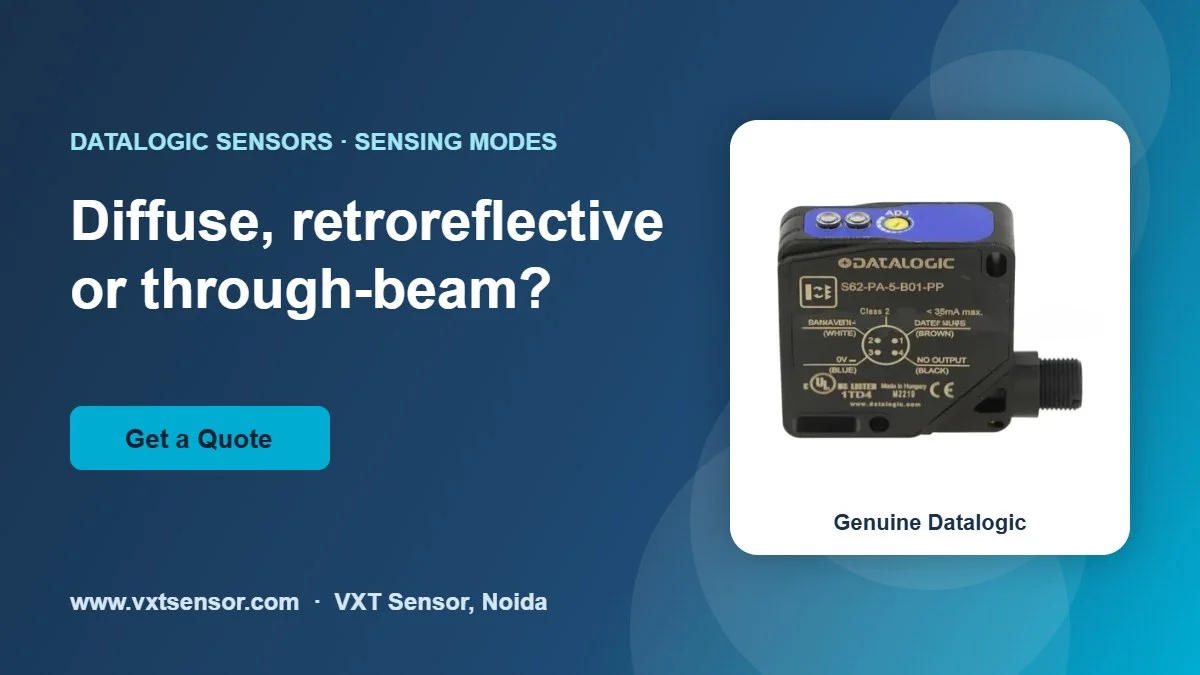
- Examples: S5N-PA-5-B01-PP, 0.1 … 4 m; S62-PA-5-B01-PP, 0.1 … 8 m; S5N-PL-5-B01-PP with a class 1 laser, 0.1 … 16 m.
4. Through-beam
Separate emitter and receiver face each other. This gives the longest range and the most reliable detection, even with dust or dark objects, but needs wiring on both sides and careful alignment.
- Use for: long distances, dirty environments and small or dark objects.
5. Special cases
- Transparent bottles and film: light passes through them. Use a retroreflective sensor made for clear objects, or an ultrasonic sensor such as the US18-PA-5-N03-VH, which senses 30 … 300 mm with sound instead of light.
- Very small parts or tight spaces: use a fibre-optic amplifier like the S7-5-E-P with a suitable fibre.
- Printed marks: use a contrast sensor; see our guide How to choose a Datalogic contrast sensor.
Quick selection table
| Your situation | Recommended mode |
|---|---|
| Short distance, simple background | Diffuse proximity |
| Different colours, shiny background | Background suppression |
| Across a conveyor, wiring on one side | Polarized retroreflective |
| Long distance or heavy dust | Through-beam |
| Clear bottles or film | Clear-object retroreflective or ultrasonic |
Get the right sensor from VXT Sensor
VXT Sensor, Noida, supplies genuine Datalogic sensors across India. Send us your machine details, the object or mark you want to detect and the distance, and we will suggest the right model, share the datasheet and confirm price and delivery. Contact VXT Sensor or browse the full Datalogic product range.
Looking for the right Datalogic sensor?
Genuine products from VXT Sensor, Noida. Tell us your application and we reply with the right model, price and delivery time.